

Joris Bijdendijk loves butter.
We’re on a canal boat, at the start of a two-day tour in celebration of the Dutch gastronomic scene. Outside, Amsterdam glimmers gold. Inside, on the table in front of us, are a giant sourdough loaf and an assortment of dairy.
Joris cuts into the sourdough, spraying crumbs all over the table. He smooshes giant lumps of butter onto the slices then tops them with a brittle cheese that came wrapped in waxy paper. Finally, he pours us a glass of buttermilk.
“The holy trinity,” he says. “Butter, milk and cheese.”
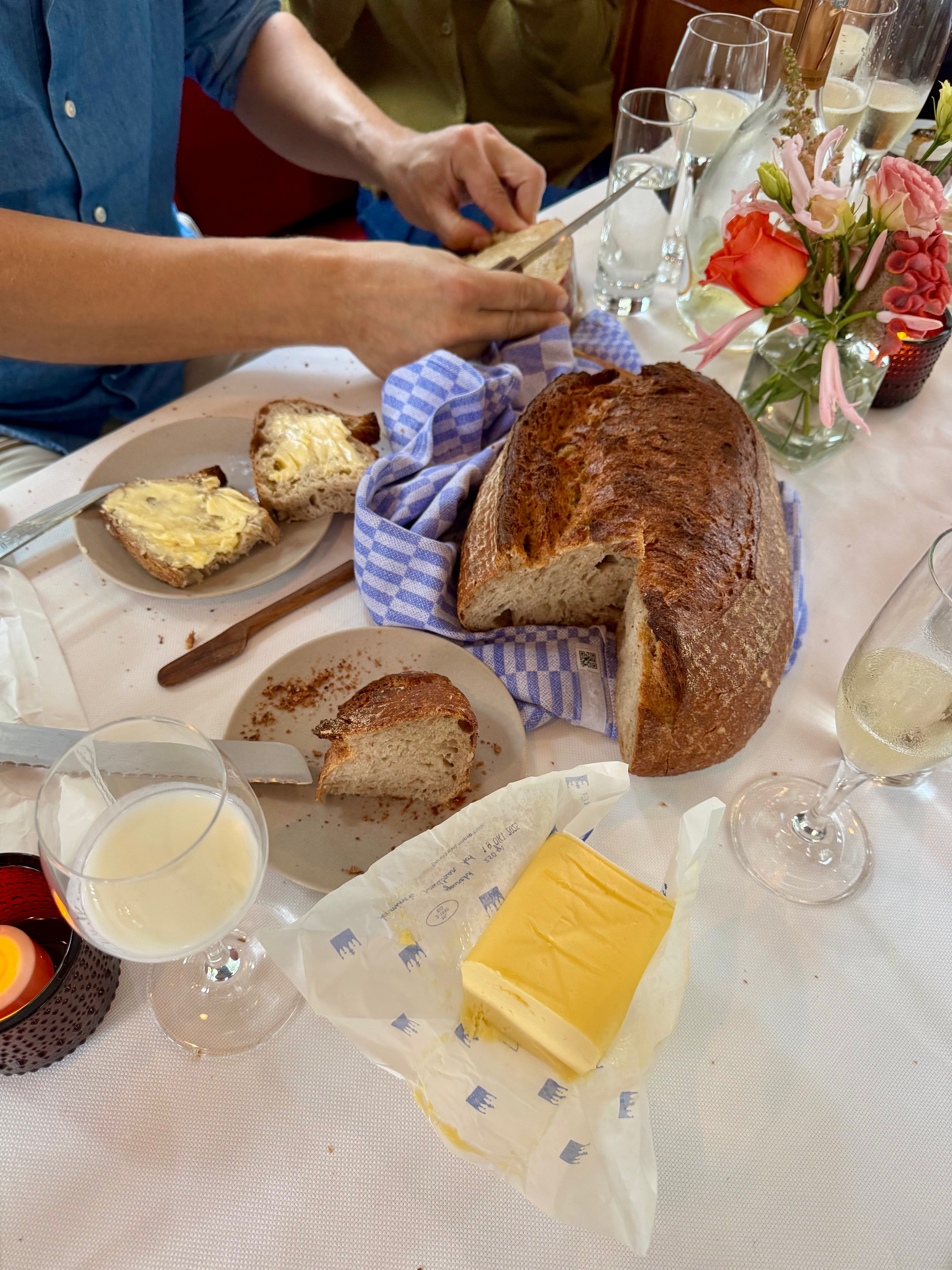
I eat my bread with butter and cheese. I wash it down with buttermilk. It is, quite simply, delicious. Serving the simplest of foods at the start of this tour, where we’ll dine in Michelin-starred restaurants, walk through abattoirs and sit in cars listening to Dutch classics on the radio, is very Joris. While his skills are stratospherically high, his feet are firmly planted in the soil. He’s never not thinking about the basics.
There’s been a gastronomic revolution in the Netherlands recently and Joris Bijdendijk is its poster boy. Not only is he head chef of two of Amsterdam’s best high-end restaurants, Rijks and Wils Restaurant, he’s a public figure too: he has multiple cookbooks, a huge Instagram following and a column in Het Parool. His celebrity is, I’m sure, helped by his traditionally good looks. When I upload a Story of him on Instagram, my DMs are flooded with questions like Who is that?? and Is he single?? I’m sent his Men’s Health cover many times.
All this is ancillary to his passion for food, which begins with butter. We’re trying a raw milk kind from De Keizerhof, an award-winning producer located south of Leiden. I pipe up with a question. Why is Dutch dairy so good?
“Is it?” Joris snaps back.
It’s not the answer I expected. Dutch dairy is, for me, one of the nation’s gastronomic strengths: the Dutch know how to make good food from cows. Go down to your weekend market and you’ll see bottles of thick milk and cuts of beef marbled with fat.
Joris doesn’t see it that way. Supermarkets, where most people shop, sell weak milk from exhausted cows (I heard something similar when I visited the Remeker farm). “You cannot rely on artisan food,” he says, “supermarkets are a necessary part of the food system.” I agree – it’d be an ecological disaster if everyone only bought beef from grass-fed cows that require huge pastures – and I’m a little embarrassed to have assumed he’d argue otherwise. Usually, chefs tell us to buy the best quality products, making us feel bad for that quick trip to Albert Heijn.
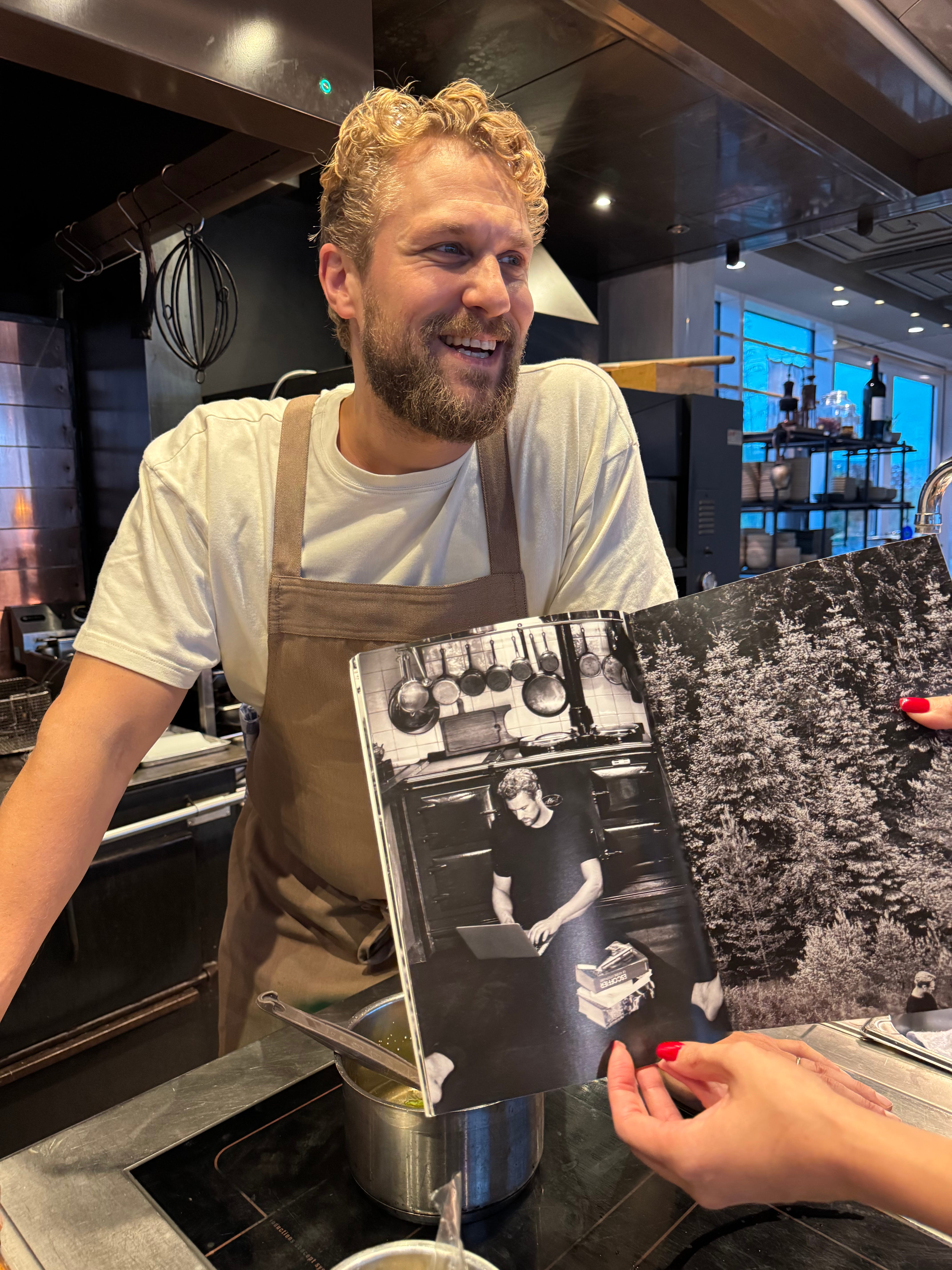
Not Joris. He’s fascinated not only by food itself but in the systems that produce it. He once asked a supermarket to follow the production of a stock cube from inception to sale to better understand how the country is feeding itself. It’s why he founded the Low Food foundation, which works to promote quality, innovation and sustainability in the industry.
That word, industry, is crucial to understanding food production in the Netherlands. This country is the factory that feeds Europe. 80% of what is grown here is exported. Despite its behemoth size, the industry remains completely hidden, tucked away in greenhouses and factory farms (slaughtering 13 million pigs a year isn’t something you want to see). The problem is that a hidden industry won’t attract talent and can’t innovate. Sustainability, as a priority, stays low. And make no mistake, we need greater sustainability in our food systems as the planet rapidly heats up and ecosystems dissolve.
Aren’t we here to talk about Dutch gastronomy, to celebrate it at its best? I quickly realise: the fight for ecological change is gastronomy at its best. Joris works passionately with Low Food on this very thing. He tells us about his practical research: his current focus is chestnuts, a highly nutritious ingredient that also promotes regenerative agriculture.
By the time our boat sails into harbour, I’ve received an education.
Our dinner is at Wils, one of Joris’ two Michelin-starred restaurants. Wils, I’m told, is his more relaxed outing. It speaks to his childhood weekends spent on a farm in the Ardennes, where the stove was never extinguished. The flames were fed by a local during the week. Those same flames are now alive in Wils’ open fire kitchen.
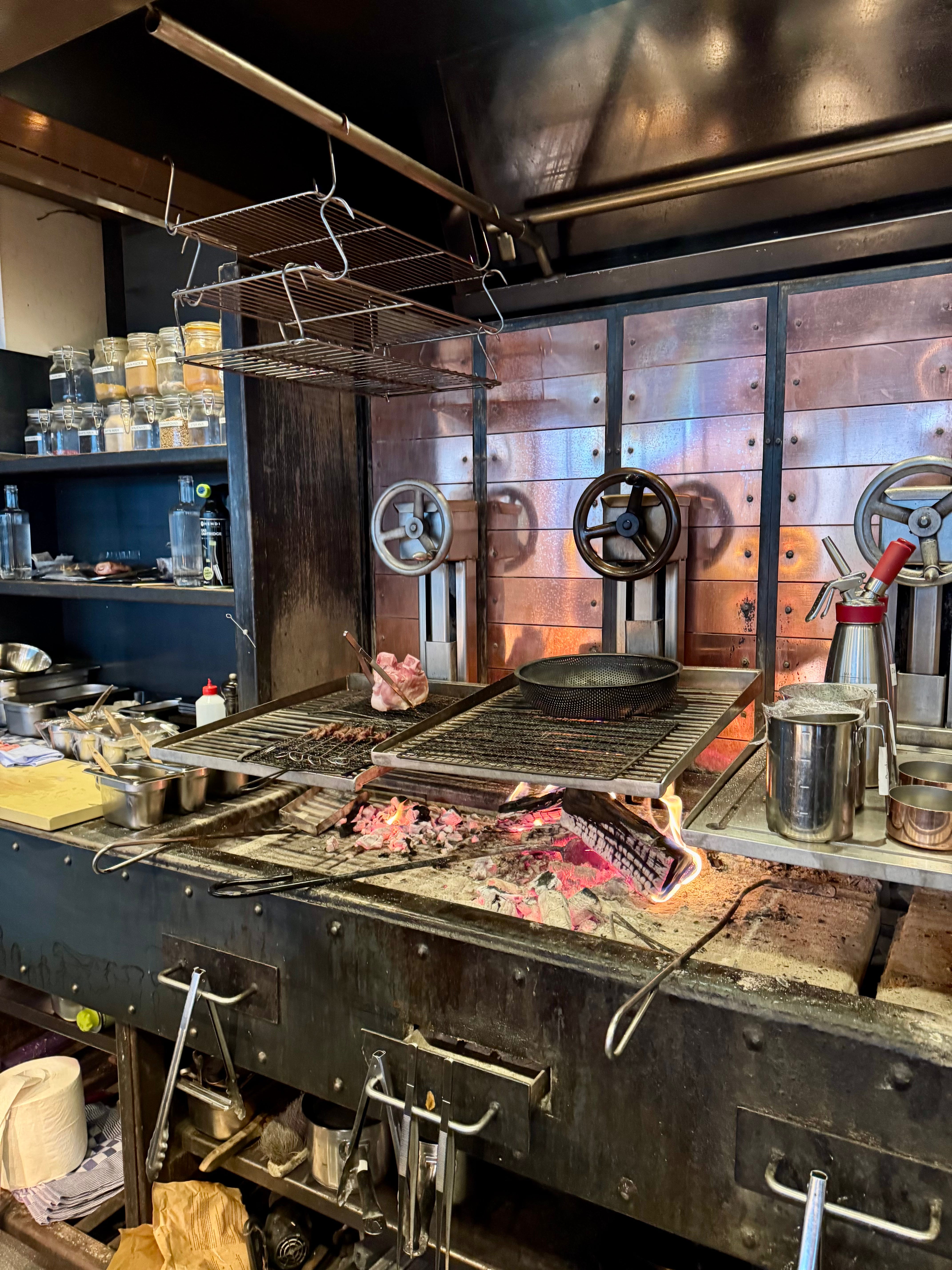
We’re shown a herb garden on an outdoor patio, then given an eyebrow-singing tour of kitchen, which looks like the engine room of a ship. Logs smoulder and fat drips. This isn’t an open fire restaurant in the ubermasculine, dick-swinging sense – there are no fat slabs of meat cooked in the caveman way. Instead, the flame is applied intelligently. Smoke curls around oyster shells. Embers slow roast a lump of pink pork.
The meal is exquisite. My rating system for Michelin-starred meals is: will I remember the dishes? From my meal at two-starred The Hand and Flowers, back in its heyday, I remember the crispy pork head starter and the duck fat chips. From Ikoyi, I can remember the jollof, but only just. At La Colombe in Cape Town, I could not, sadly, tell you a single thing I ate, other than the meal tasted Michelin-y.
Wils produces at least three dishes that will stay with me for life. A cured hamachi served on a snap-able plane of nori – a dish that, with its grey plating and morbid colouring, looks like the Death Star. Its taste is fantastically clean. Eating it reminds me, in a strange way, of applying a coat of a paint onto a wall. We’re given a crayfish and cocoa dish with a texture like mochi. It’s in no way confusing. It tastes like honesty. But the dish of the night, the one I’ll carry in my heart, is the squid, cut into noodles, served with gochujang and cabbage. It’s sophisticated while retaining a charming, backstreet boisterousness.


The meal, overall, is low on meat. Joris thoroughly measures the environmental impact of his dishes and plants are simply better for the planet. He comes over from the kitchen at regular intervals. Listening to him talk is like flicking through a notebook filled with random scribblings. There’s a story about trying to open a butter farm on the roof of Wils (he really does love butter). A homily on the importance of learning how to butcher meat. A history lesson on Dutch gastronomy, dating back to the 1970s. He talks, at length, about the importance of working with small producers.
We see this the morning after Wils, when Joris takes us on a tour of Lindenhoff farm, his longstanding supplier of meat, dairy and vegetables. At the weekends, Lindenhoff becomes a bucolic farm shop. Piglets squeal. Cabbage is everywhere, growing furiously. It’s a charming place but I’m slightly tired. I had what I call Fine Dining Dreams, where my REM goes to the edge of the universe and back again.


A walk into the abattoir to see hanging carcasses perks me up. Joris makes us smell the hanging meat for its nutty funk. He enjoys a bit of shock value. All big-name chefs do (we once had a two-star chef cook us lunch at culinary school, they chose a menu of lamb’s brains). Later, Joris takes us on a tour of Albert Cuyp, where we eat some Surinamese sausages that are boiled at the back of a pokey, bright-yellow shop. It’s just sausage, eaten on the street. We’re back to basics again.
This, he assures us, is Dutch gastronomy at its best too.
Back at Wils, the fat, chat and wine are swirling within me. I ask Joris a question I’ve been so far a little scared to ask.
But what is Dutch gastronomy?
I ask because I struggle to define it. I want to be able to. As a British-Polish eater, I find Dutch cuisine difficult to locate, and I mean that in the geographical sense: Amsterdam is not filled with Dutch eateries. My experiences have been so far limited to bitterballen and stroopwafels and a few restaurants, such as VRR, where I’ve been served dishes like stamppot.
Mentioning a stereotypical dish like stamppot might induce an eye roll from a Dutch person (I was irked by how often I was asked about fish and chips when I lived in Japan) but surely cuisines can, and should, keep space for old school dishes? Take British cuisine: Sunday roasts and chicken pies and leek and potato soup are common dinners. I know what British cuisine is, in that I can tell you it’s centred, wholly, around a hot oven. I can similarly conceptualise Polish food. It’s plucked from the field and found in the forest, and then it’s cooked with love and smoke and salt.
But Dutch food? What is it, at its simplest? Joris doesn’t give me a straight answer, other than to ask back, rhetorically, “How do you define something like that?”
I realise, then, that he’s been answering that question our whole time together. Dutch cuisine is no longer mashed potato. It once leant on French gastronomy but the crutch has since been thrown away. It’s beautiful Dutch ingredients, which are being (re)discovered. It’s outward-looking. It’s inclusive of Indonesian and Surinamese flavours. It’s a frenzy of activity, a booming bakery scene, a densification of restaurants. It’s small producers finessing toasties and chilli oils. It’s young chefs doing bold things while keeping it casual. It’s tables without clothes, kitchens without walls. It’s honest, like its people. Wat de boer niet kent, dat vreet hij niet – what the farmer doesn’t know, he doesn’t eat, the saying goes, and yet Amsterdam is now 12th in the world when it comes to total number of Michelin stars. So it’s the farmer becoming curious. It’s chefs like Joris. It’s tackling the environment through food. It’s many things. It’s too complex to be defined. At least at this critical juncture.
Crucially, and perhaps this is the cause of my struggle, Dutch cuisine is humble. It doesn’t like to shout about itself. But based on my two days with Joris, eating high-end and ground up, I learn that Dutch cuisine is powerful. With Joris as its excellent champion, it’ll find its place on the world map.
I leave Wils feeling like I’ve read a good poem. A good poem, by my definition, is something you cannot fully understand. You know it works but you give up trying to understand why.
I give up trying to understand Dutch food in a neat way. At this point in time, it’s undefinable. And that, I learn, is its strength.
Wow! Really nice piece! Love your description about what is Dutch gastronomy. I am working on something for Lowfood, and will definitely reach out to you! :) Love, Elody
I spent my 60th birthday in Amsterdam this past August to be with my family who live there. We had a fantastic dinner at a Dutch Michelin-recognized restaurant, which is a family favorite. I have always loved eating in Holland and am excited to read your post.